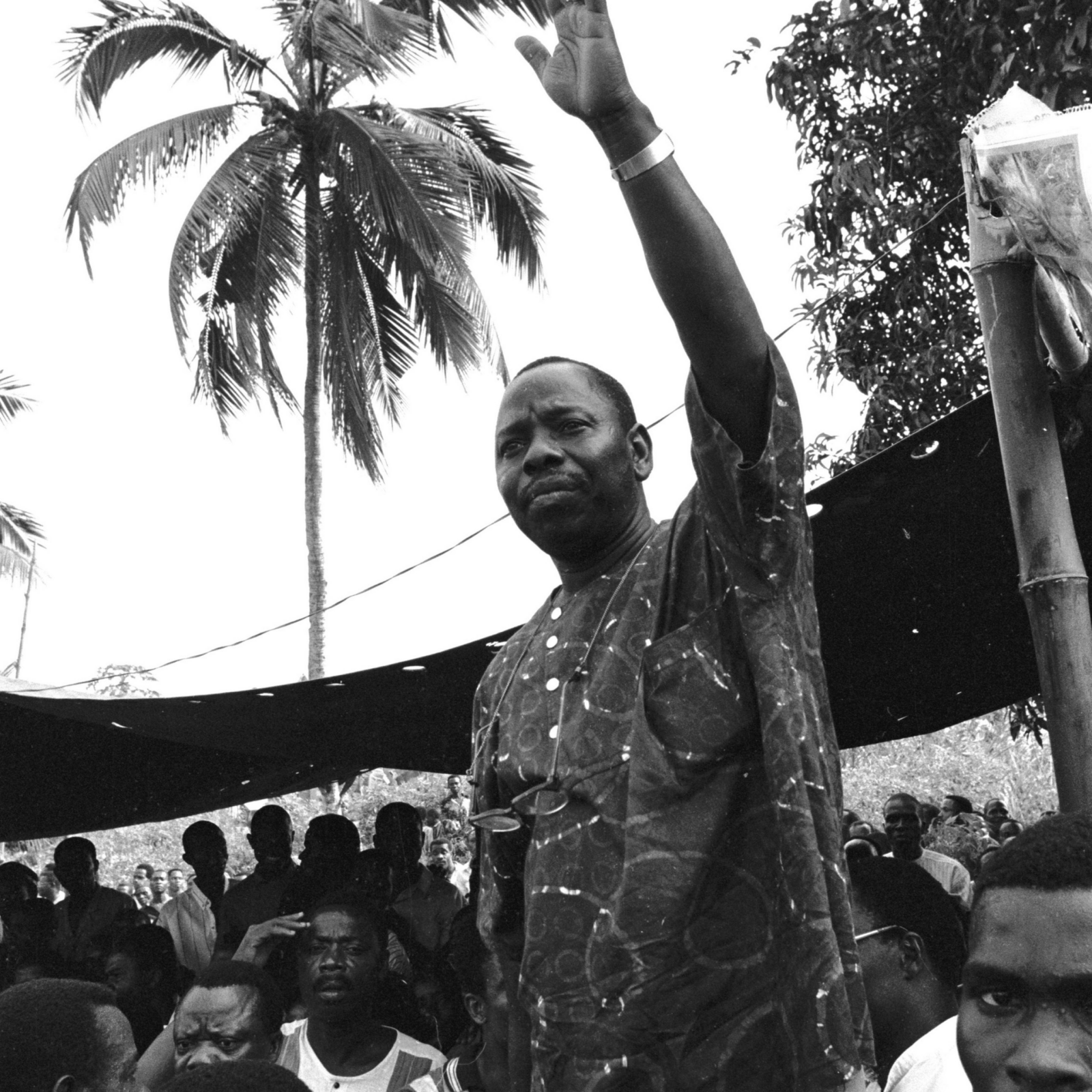
Ken Saro-Wiwa was a Nigerian writer, producer and most importantly an activist who belonged to the Ogoni ethnic group, located in the Niger Delta.
The activist was born Kenule Beeson Saro-Wiwa and was raised in the village of Bori, near Port Harcourt, in Rivers State, Nigeria, formerly part of the Ogoni region.
He and his brother, Owens Wiwa, were brought up in an Anglican Christian household and received their primary education at the Native Authority School in Bori before attending secondary school at Government College Umuahia.
Saro-Wiwa was a highly distinguished student and, as a result, earned a scholarship to study English at the University of Ibadan.
Works & Career:
Ken Saro-Wiwa was a successful businessman and television producer. His satirical TV series, ‘Basi & Company‘, popular nationally, with over 30 million viewers. Most of his TV shows and writings were satire; made to portray a counter-image of Nigerian society.
Saro-Wiwa later served as Commissioner for Education in Rivers State from 1968 to 1969.
In the 1970s, Saro-Wiwa had several successful business ventures in retail and real estate. He later entered the political sphere in 1977 and narrowly missed out on representing Ogoni in the Constituent Assembly by a small margin.
As he became more politically engaged, his writing grew less satirical and increasingly focused on environmental and social justice.
While studying at the University of Ibadan, he wrote the play Transistor Radio, which resonated with much of Nigerian society. Transistor Radio was later adapted for radio in 1972.
Politics:
Ken Saro-Wiwa first entered politics in from 1968-1969 during Nigeria’s brutal civil war. During this time he was appointed Commissioner for Education in Rivers State under the military governor Alfred Diete-Spiff.
In the years of 1970-1973 Saro-Wiwa was Regional Commissioner for Education in the Rivers State[17] Cabinet, but later dismissed in 1973 for his support for Ogoni autonomy.
As already mentioned he marginally lost out on representing Ogoni in the Constituent Assembly which prompted focus on his literary works such as Sozaboy: A Novel in Rotten English as well as aforementioned creative works & business ventures.
Following this period the environmentalist, although politically aware, didn’t formally involve himself in politics until 1987 after he was appointed as the newly-installed leader to aid Nigeria’s transition to a civilian government. Saro-Wiwa soon resigned from the role after he felt that Babangida wasn’t ready for this transition. The ‘Basi & Company’ producer was proven right after the annulment of the 1993 election. Many believe that Moshood Abiola was the rightful winner.
Environmental activism & MOSOP:
In 1990 Ken Saro-Wiwa would form MOSOP (Movement for the Survival of the Ogoni People). MOSOP was founded to represent the Ogoni people and advocate for environmental justice after decades of exploitation from Shell & other multination oil conglomerates, who polluted rivers & fertile land whilst providing no economic benefit to the minority group.
MOSOP would lead countless peaceful protests and drafted the Ogoni Bill of Rights, demanding:
“Political control of Ogoni affairs by Ogoni people, control and use of Ogoni economic resources for Ogoni development, adequate and direct representation as a right for Ogoni people in all Nigerian national institutions, and the right to protect the Ogoni environment and ecology from further degradation.”
The bill also said that Shell bore “full responsibility for the genocide of the Ogoni.”
In August 1990, MOSOP presented the Bill of Rights to several parties: the Federal government of Nigeria, Greenpeace and other organisations. The Ogoni case was presented to the Unrepresented Nations and Peoples Organization in 1993.
Take the time out to read the full Ogoni Bill of Rights here.
MOSOP’s peaceful protests led to reprisals by the government’s paramilitary arm of the police force, the Mobile Police Force (MPF), also known as the Nigerian Mobile Police. In October 1993, Shell anticipated protests at its facility in the Umuechem community of Etche and requested that the MPF be deployed. The MPF killed at least 80 unarmed protesters and damaged or destroyed almost 500 homes. A later government inquest concluded that the MPF’s violence was carried out in “reckless disregard for lives and property.”
Execution of the Ogoni Nine:
MOSOP was an umbrella group which held multiple factions within (As do many Nigerian political groups).
On May 21, 1994, four Ogoni chiefs who sided with the conservative schism of MOSOP were murdered by a splinter group associated with MOSOP. The murdered chiefs were later dubbed the Ogoni Four.
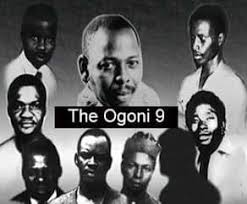
Ken Saro-Wiwa and eight colleagues were later dubbed the Ogoni Nine after being arrested in connection with the murders. One of the accused was Barinem Kiobel, who was not a MOSOP member but held a senior government position and had been critical of the military’s actions in Ogoniland.
The Ogoni Nine were tried under a military tribunal and later convicted and sentenced to death between October 30 and 31, 1995. A British criminal lawyer who observed the sham trial stated that “the Tribunal first decided on its verdict and then sought arguments to justify it. No barrel was too deep to be scraped.” The trial was widely labelled as politically motivated and biased.
Saro-Wiwa, alongside the other members of the Ogoni Nine, was executed on November 10, 1995, under the regime of dictator Sani Abacha.
Shell complicity:
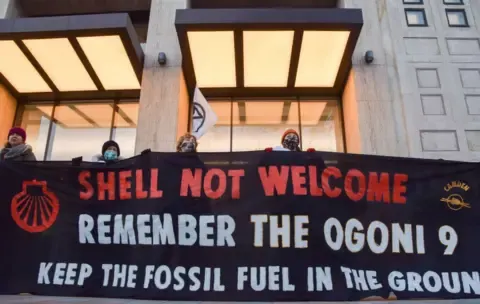
Internal Shell documents seen by Amnesty International showcase evidence that Shell knew that the trial of the Ogoni Nine was unfair.
Shell also knew that Nigerian authorities had committed “grave violations” when addressing community protests. Under international law, their encouragement of Nigerian security forces to deal with the “Ogoni problem” made them complicit in the atrocities.
The Anglo-Dutch company would regularly remind the military government of the economic cost of peaceful protest. “Community disturbances, blockades, and sabotage” had led to a drop in production of almost nine million barrels over the course of the year, and Shell asked for help to minimise these disruptions. In the letter, Shell named the communities, including those in Ogoniland, where these “community disturbances” had taken place.
Legacy of Ken Saro-Wiwa & the Ogoni Nine:
The execution of the Ogoni Nine led to international condemnation of Nigeria’s military regime. This condemnation resulted in Nigeria being suspended from the Commonwealth for three years, as well as an arms embargo imposed by the EU.
Ken Saro-Wiwa was awarded the Goldmans Environmental Prize in 1995 (Posthumously) for defending human rights in Ogoniland & his Environmental activism. He was also awarded the Right Livelihood Award (often referred to as the “Alternative Nobel Prize”) in 1995 for “exemplary courage in striving non-violently for civil, economic, and environmental rights.”
His activism led to legal battles involving Shell and other multinational oil companies; additionally, later rulings declared practices such as gas flaring unconstitutional.